You have saved several photos of fine line tattoos and like that delicate finish. But before choosing, questions come up: will it look the same on my skin? Can I have it that small? What will happen to the lines over time?
Fine line tattooing allows for delicate lines, but not every reference works at every size or on every part of the body. Let us go through what to look at so you can discuss your idea with your tattoo artist and understand their recommendations.
Table of Contents
What is a fine line tattoo?
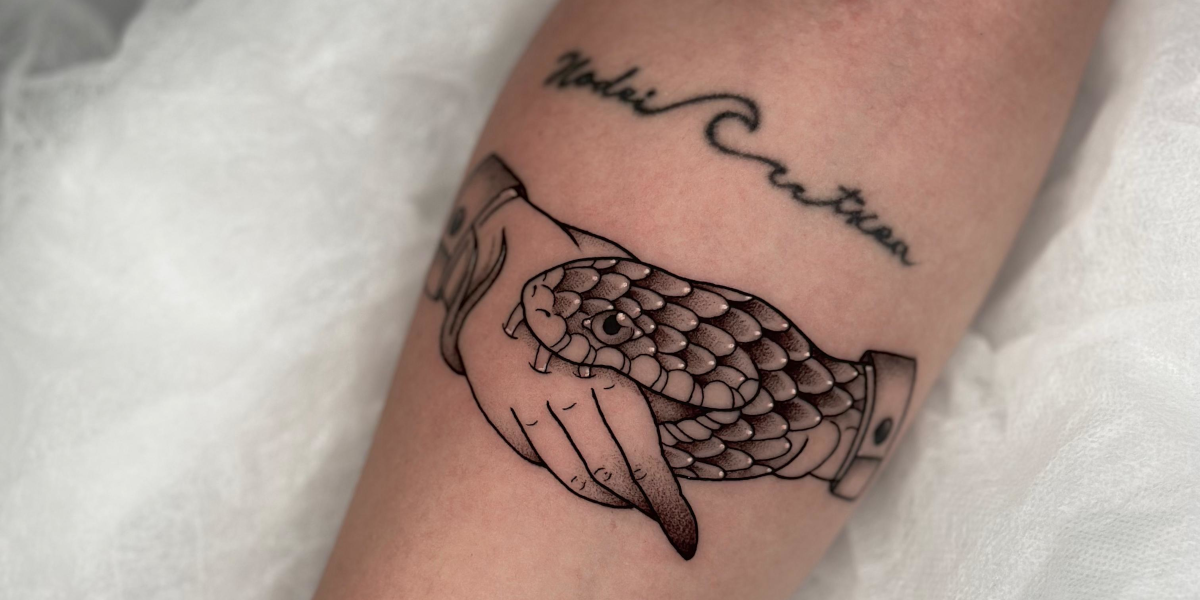
It is a style that uses thin lines to draw letters, flowers, silhouettes, geometric shapes and other motifs. It can be done with different needle configurations: it is not defined solely by using a single needle point.
It does not have to be tiny either. A slightly larger piece can keep that delicate look while leaving more space between its details.
- Lettering: needs enough size and spacing to remain readable.
- Botanical designs: leaves and flowers can be simplified to keep the lines from merging.
- Geometry: how the lines fit the curve of your chosen area matters.
- Silhouettes: can work with just a few elements, without copying every detail of a photograph.
What to look for when choosing a tattoo artist
A small tattoo is not necessarily a simple one. When comparing work, look at the continuity of the lines, the space between them and how easily you can recognise the drawing.
If there are photos of healed pieces, look at those too. A photo taken straight after a session cannot tell you on its own how the tattoo will look later.
Technique matters, but you do not need to learn machine settings to choose an artist. You should, however, be able to ask why they recommend a particular size, placement or simpler version of the design.
Do fine lines fade over time?
All tattoos change over the years. Lines can lose intensity or definition, and the result depends on the tattooing, your skin, placement and aftercare. It would not be realistic to promise that a piece will stay identical or perfect for life.
- Size and detail: squeezing too many lines into a very small space can make the design harder to read.
- Placement: areas such as fingers need careful consideration of friction, daily use and how the tattoo may change.
- Aftercare: follow the healing instructions and protect your skin from the sun once it has healed.
If a design has lots of detail in very little space, those details may become harder to distinguish over time. So when your tattoo artist suggests going slightly bigger or spacing out the lines, it is worth understanding why before you decide.
In some cases, a touch-up may be considered. That is not something that can be decided just by looking at a photo before tattooing: the healed piece will need to be assessed.
How to adapt the idea you have saved
A reference helps explain what you like, but it does not have to become an exact copy. You can bring several and point out what appeals to you in each: the lines, composition, placement or size.
If you want a small portrait, a long phrase or a flower with lots of detail, some simplification may be needed. Removing elements does not have to weaken the drawing: it can make it easier to recognise.
Before you begin, look at the stencil on your skin while standing or sitting naturally. Check that you like the size and that it faces the way you want.
How to care for your skin after the session
Fine lines need aftercare too. Do not assume the tattoo will heal faster or need less attention just because it has less fill.
- Follow your tattoo artist’s instructions on the dressing, cleaning and moisturising.
- Do not scratch or pick at peeling skin or scabs.
- Avoid friction and direct sunlight during healing.
- If you notice increasing pain, intense warmth, discharge or spreading redness, seek medical assessment.
Getting your questions answered before your tattoo
At Bon Vivant Tattoo Studio, on Calle Montera in Madrid, you can share your references and discuss the size, placement and finish you are looking for.
You do not need to have every detail worked out. What matters is that you understand the proposal and can raise anything you are unsure about before you start.