You like black ink and want a tattoo with a strong presence. But when you look at blackwork references, you might find anything from a simple figure to compositions covering much of an arm. How do you know what could work for your idea?
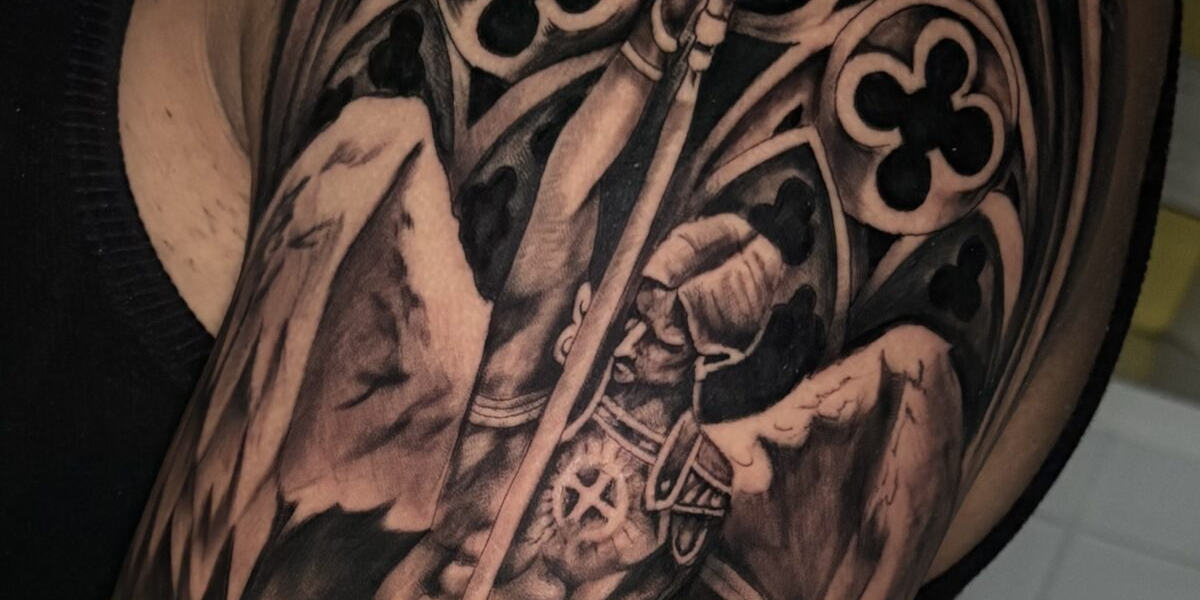
Blackwork puts black ink at the centre of the design. The important thing is not to fill every space, but to decide where to place black and where to let the skin show so the drawing is clear. Let us look at how contrast, placement and size play a part.
What makes a black design easy to read
A design can include solid blocks, lines, geometric patterns, botanical motifs or ornamental elements. The result changes with the visual weight of each part and the space between them.
If every area has the same intensity, the shapes can be hard to distinguish. Leaving areas untattooed does not mean the design is unfinished: those gaps can bring light into it and separate elements.
- Contrast: the difference between dark and light areas that makes the composition recognisable.
- Negative space: areas where the skin is left without ink and which are also part of the drawing.
- Shading: can add volume or soften a transition when it suits the design.
When comparing references, look closely and from a little distance. Ask yourself what you see first and which detail you would want to keep if the design had to be simplified.
How it changes with the area of the body
A motif that works on a back cannot necessarily be scaled down unchanged for a wrist. The shape of the area, movement and available space change the proportions and the amount of detail worth including.
On a forearm, for example, it helps to see how the composition wraps around the arm, not just how it looks in a photo taken from the front. The stencil lets you check its position and say if any part feels too large or visually heavy.
For references on composition and shading, you can look at the work of Santiago Zuluaga. You do not need technical terms to describe your idea: explain which shapes appeal to you and what result you do not want.
Can it cover an old tattoo?
In some projects, black ink can be part of a cover-up. But not every tattoo can be covered with any design, and simply adding more ink on top is not enough.
The existing piece, its colours, size and the condition of the skin need assessing. The proposed design may need more space than you imagined or a different approach. That assessment should happen before the new drawing is finalised.
Planning your session and caring for the result
If the composition is large or has a lot of solid fill, ask how the sessions will be organised and what care the area will need. Understanding the timing helps you plan with more peace of mind.
After your tattoo, follow the instructions on cleaning, dressings and moisturising, and avoid direct sunlight during healing. Once the skin has healed, keep it protected from the sun. Black ink changes over the years too: no technique can guarantee it will stay unchanged forever.
At Bon Vivant Tattoo Studio, on Calle Montera in Madrid, you can share your references and compare size and placement options. The idea is to create a piece you like without expecting you to work out every detail on your own.